
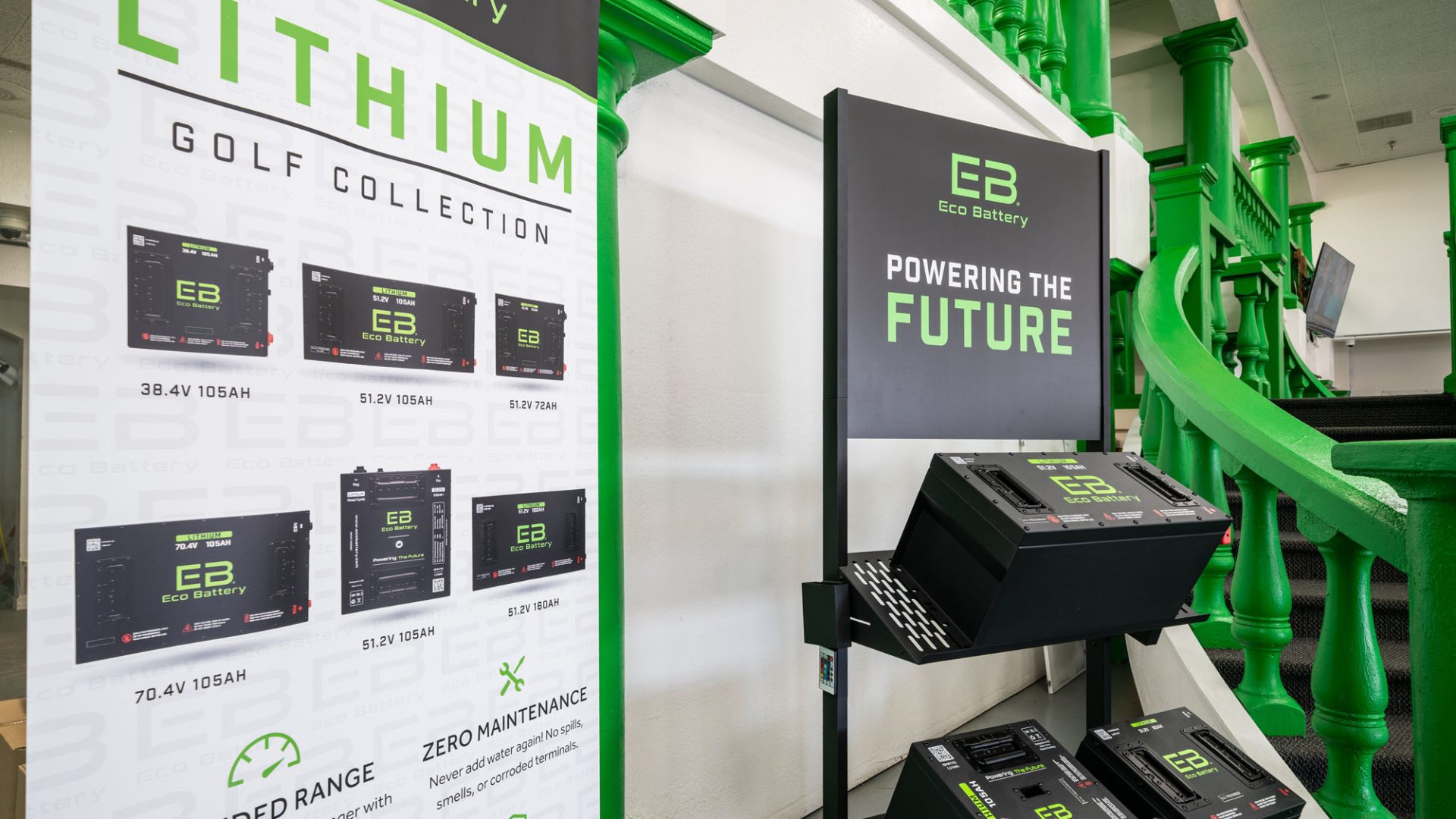
Most flooded lead-acid golf cart batteries last approximately three to five years, while AGM batteries may last four to six years. A properly matched lithium golf cart battery can often last eight to ten years or longer. Actual battery life depends on the battery, driving habits, charging routine, maintenance, passenger load, storage conditions, and exposure to heat.
Arizona’s climate can be especially demanding. Long periods of extreme heat may accelerate battery aging, increase water loss from flooded batteries, and place additional stress on the charging system. Knowing the warning signs of a weak battery can help you schedule testing before your cart loses power completely.
This guide explains how long different golf cart batteries typically last, how Arizona heat affects them, what replacement may cost, and when converting to lithium could make more sense than installing another lead-acid pack.
Average Golf Cart Battery Lifespan by Type
Battery life is commonly measured in years, but age does not tell the entire story. The number and depth of charge cycles, operating temperature, maintenance history, and remaining capacity all affect how long a battery remains useful.
| Battery Type | Typical Lifespan | Watering Required? | Relative Upfront Cost |
|---|---|---|---|
| Flooded lead-acid | Approximately 3–5 years | Yes | Lower |
| AGM or sealed lead-acid | Approximately 4–6 years | No | Moderate |
| Lithium | Approximately 8–10+ years | No | Higher |
These are general planning ranges, not guarantees. A well-maintained battery may last longer, while one exposed to repeated deep discharging, improper charging, or extreme heat may need replacement much sooner.
Flooded Lead-Acid Golf Cart Batteries
Flooded lead-acid batteries are commonly found in older carts and lower-cost electric models. They generally have the lowest initial replacement price, but they also require the most routine maintenance.
These batteries contain removable vent caps and must be checked periodically to confirm that the electrolyte remains at the proper level. Arizona heat and frequent charging may increase water consumption. Allowing the water level to fall low enough to expose the internal plates can cause permanent damage.
Flooded batteries also need clean terminals, secure cable connections, compatible charging equipment, and protection from extended periods in a discharged state. Our complete golf cart battery maintenance guide explains how to charge, water, inspect, and clean these systems safely.
AGM Golf Cart Batteries
AGM batteries are a sealed type of lead-acid battery. They do not require watering, which makes them more convenient for owners who want to reduce routine maintenance without completing a lithium conversion.
They still require the correct charger and regular inspection. Deep discharging, excessive heat, poor storage, and incompatible charging can shorten their life. AGM batteries should never be opened or filled with water.
Lithium Golf Cart Batteries
Lithium batteries generally offer the longest potential service life. They do not require watering and are usually much lighter than a traditional lead-acid battery pack. Depending on the system, they may also charge faster and provide more consistent power as the battery level falls.
A lithium battery relies on a battery management system to monitor temperature, voltage, charging, and other operating conditions. The battery, charger, wiring, controller, and cart must be compatible. Lithium batteries also have approved charging, operating, and storage temperature ranges that vary by manufacturer.
Some lithium systems include warranties lasting up to ten years, but warranty length should not be treated as a promise that every battery will provide the same lifespan.
Why Golf Cart Batteries Wear Out Faster in Arizona
Heat affects the chemical processes inside every battery. While batteries need some warmth to operate efficiently, repeated exposure to extreme temperatures can accelerate aging and reduce long-term capacity.
High Ambient Temperatures
A golf cart parked outside or inside a poorly ventilated garage can become much hotter than the reported outdoor temperature. That heat can affect the batteries, charger, cables, and electrical connections.
Whenever possible, store the cart in a shaded, dry, and ventilated location. Avoid placing the charger next to a major heat source or covering it while it is operating.
Faster Water Loss From Flooded Batteries
Flooded lead-acid batteries lose water during normal operation and charging. Hot Arizona weather may increase the frequency of needed water checks.
Use distilled water only and follow the battery manufacturer’s instructions. Overfilling can allow electrolyte to escape during charging, while underwatering can expose and damage the plates.
Charging During Extreme Heat
Charging naturally generates heat. Placing the cart and charger in direct sunlight or an enclosed space can make it harder for that heat to escape.
Always charge within the temperature range approved by the battery and charger manufacturers. Stop charging and schedule an inspection if you notice unusual heat, melted insulation, repeated charger faults, smoke, or a strong odor.
Long-Term Summer Storage
Many seasonal Arizona residents leave their carts unused during the summer. A battery can lose capacity or suffer permanent damage when stored improperly for several months.
Storage instructions vary by battery type. Lead-acid batteries generally should not be left in a discharged condition, while lithium systems may have specific storage-charge recommendations. Follow the instructions for your battery rather than using one storage routine for every cart.
What Affects Golf Cart Battery Life?
Two identical battery packs can provide very different service lives depending on how the carts are used and maintained. The following factors have the greatest effect.
Charging Habits
Repeatedly running lead-acid batteries until the cart becomes noticeably slow can reduce battery life. Using the wrong charger, interrupting charge cycles, or leaving the cart discharged can also cause problems.
Use a charger that matches the battery chemistry and complete pack voltage. Allow the charger to complete its normal cycle and follow the manufacturer’s instructions for charging after use.
Passenger and Cargo Weight
A cart carrying several adults requires more energy than the same cart carrying one person. Rear seats, cargo beds, oversized tires, coolers, and other accessories also increase weight.
Regularly operating near or beyond the cart’s weight limit can reduce range and increase demand on the battery, motor, controller, brakes, and suspension.
Terrain and Driving Habits
Hills, rapid acceleration, frequent stops, high speeds, and soft surfaces all require more energy. A cart used on flat community streets may place less demand on its batteries than one driven on steep or uneven terrain.
Tire and Brake Condition
Low tire pressure increases rolling resistance, causing the motor and batteries to work harder. Brake drag, wheel problems, and improper alignment can also reduce range.
A sudden loss of distance does not automatically mean the battery is failing. The complete cart should be checked for mechanical and electrical problems.
Maintenance and Storage
Correct watering, clean connections, compatible charging, shaded storage, and timely testing can help protect battery life. Neglected batteries may fail early even when the cart is rarely driven.
Signs Your Golf Cart Batteries May Need Replacement
A battery pack does not have to be completely dead to affect your cart. Watch for changes in range, acceleration, charging time, and overall performance.
1. Your Driving Range Has Decreased
Reduced range is one of the most common signs of battery deterioration. You may notice that the cart no longer completes familiar trips or that the battery gauge drops more quickly than it did before.
Compare performance under similar conditions. Passenger weight, hills, temperature, speed, and tire pressure can all change range. If the cart continues to travel less distance after a complete charge, the battery pack should be tested.
2. Acceleration Feels Slower
A weak battery pack may cause delayed acceleration or sluggish starts. The cart may also feel noticeably slower when carrying passengers.
Battery problems are not the only possible cause. Loose cables, motor problems, controller faults, and dragging brakes can produce similar symptoms.
3. The Cart Struggles on Hills
Batteries that have lost usable capacity may have difficulty supplying power under heavier demand. The cart may slow substantially on hills or struggle when passengers are added.
If hill-climbing performance changes suddenly, have the batteries and related electrical components inspected.
4. Charging Takes Longer Than Normal
A charging cycle that becomes much longer may indicate battery deterioration, but it could also point to a charger or connection problem. Other warning signs include a charger that will not begin, will not finish, or repeatedly displays an error.
Test the complete charging system before replacing the batteries.
5. The Cart Loses Power Soon After Charging
A battery may show a full charge without maintaining that energy under load. The cart may operate normally at first and then lose power much sooner than expected.
Professional discharge or load testing can measure how the pack performs under real operating demand.
6. Battery Terminals Keep Corroding
White, blue, or green buildup around the terminals may result from electrolyte residue, moisture, overfilling, charging problems, or loose connections.
Minor corrosion can sometimes be cleaned, but recurring or severe buildup should be professionally diagnosed. A loose or corroded connection can create resistance, generate heat, and reduce performance.
7. A Battery Case Is Swollen, Cracked, or Leaking
Physical damage is a serious warning sign. Stop using and charging the cart if a battery is swollen, cracked, leaking, smoking, or producing a strong sulfur-like odor.
Keep people away from the battery area and contact a qualified golf cart service provider. Do not open or attempt to repair a damaged battery.
8. A Battery or Cable Becomes Unusually Hot
Unusual heat may indicate a loose connection, excessive resistance, internal battery damage, or a charging problem. Continuing to operate the cart could damage other components or create a safety risk.
9. The Battery Pack Is Several Years Old
Age alone does not prove that a battery needs replacement. However, an older battery pack deserves closer attention when range, charging time, or acceleration begins to change.
Keep a record of the battery installation date, warranty, and service history. This information will help a technician evaluate whether repair, replacement, or conversion makes the most sense.
Is It the Battery or the Charger?
Several golf cart problems can look like battery failure. Before purchasing a new pack, rule out:
- A damaged charger or charging cable
- A loose or corroded connection
- An incompatible charger
- A damaged charging port
- A lithium battery management system fault
- A motor or controller problem
- Brake drag
- Low tire pressure
Replacing the batteries without finding the actual cause can lead to an unnecessary expense. It may also allow a charging or electrical problem to damage the replacement pack.
How Are Golf Cart Batteries Tested?
A professional battery inspection should evaluate the batteries, cables, terminals, charger, and related electrical components.
Visual Inspection
The technician begins by looking for corrosion, loose connections, damaged cables, leaks, swelling, cracked cases, and signs of overheating.
Voltage Testing
Voltage readings can identify differences between individual batteries. However, voltage alone does not reveal how much usable capacity remains. A battery may show acceptable voltage while resting and still fail under load.
Hydrometer Testing
A hydrometer measures the specific gravity of the electrolyte inside an accessible flooded lead-acid battery. It can help identify differences between cells but does not apply to sealed AGM or lithium batteries.
Battery electrolyte is corrosive, so this procedure requires appropriate safety equipment and experience.
Load or Discharge Testing
A load or discharge test measures how the battery pack performs while supplying power. This provides a better picture of usable capacity and can identify batteries that lose voltage quickly under demand.
Charging-System Testing
The charger should also be tested to confirm that it starts, produces the correct output, and completes its normal cycle. This is especially important when the cart has repeated charging problems.
Should You Replace One Battery or the Complete Pack?
Traditional lead-acid golf carts commonly use several batteries connected as one pack. If one battery fails, it may be tempting to replace only that unit.
In most cases, the pack should contain batteries of the same chemistry, voltage, capacity, and approximate age. Mixing a new battery with several older batteries can create an unbalanced system. The new battery may be forced to work differently from the others, reducing performance and potentially shortening its life.
A technician should test every battery before making a recommendation. If the entire pack is the same age and one battery has failed because of normal deterioration, the others may be approaching the end of their useful lives as well.
How Much Does Golf Cart Battery Replacement Cost?
The cost of replacing golf cart batteries depends on the battery chemistry, pack voltage, capacity, number of batteries, cart model, charger compatibility, installation, and warranty.
A traditional flooded lead-acid pack generally costs less upfront than a complete lithium conversion. However, it requires ongoing watering and may need replacement more frequently.
Golf Car Superstore currently offers the following professional lithium conversion options:
| Lithium System | Current Installed Price |
|---|---|
| 51V 105Ah lithium battery | $2,910.95 out the door |
| 51V 160Ah lithium battery | $3,867.65 out the door |
| 70V 105Ah lithium battery | $3,686.94 out the door |
These prices include the ECO lithium battery system, professional installation, shop supplies, and tax. Pricing can change, so confirm the current amount and system compatibility before scheduling service.
For more information about battery capacity and installation pricing, read our guide to the cost of upgrading a golf cart to lithium.
Lead-Acid Replacement vs. Lithium Conversion
If your existing lead-acid pack is approaching the end of its life, this is a good time to compare another lead-acid pack with a lithium conversion.
| Consideration | Lead-Acid Replacement | Lithium Conversion |
|---|---|---|
| Initial cost | Usually lower | Usually higher |
| Watering | Required for flooded batteries | Not required |
| Battery weight | Heavier | Usually lighter |
| Charging time | Generally longer | Often faster |
| Power delivery | May decline as charge falls | Generally more consistent |
| Potential lifespan | Shorter | Longer |
| Charger requirements | Existing charger may be compatible | Compatible lithium charger required |
When Lead-Acid Replacement May Make Sense
A new lead-acid pack may be a practical choice if you want the lowest immediate cost, use the cart only occasionally, and are comfortable performing routine battery maintenance. It may also make sense if the cart will not be kept long enough to justify the higher cost of conversion.
When a Lithium Conversion May Make Sense
A golf cart lithium battery conversion may be worth considering if you use the cart frequently, want to eliminate watering, prefer faster charging, or plan to keep the cart for several years.
Lithium may also be helpful when reduced battery weight, more consistent power, and longer potential service life are priorities. The system must be selected and installed based on the cart’s voltage, controller, motor, wiring, charger, and available battery space.
How to Help Golf Cart Batteries Last Longer in Arizona
Proper care cannot prevent every battery failure, but it can reduce premature deterioration.
- Use a charger designed for the battery type and pack voltage.
- Do not leave lead-acid batteries discharged.
- Check flooded-battery water levels regularly.
- Use distilled water and never add acid during routine watering.
- Keep terminals and cable connections clean and secure.
- Store the cart in a shaded and ventilated location.
- Maintain the recommended cold tire pressure.
- Stay within the cart’s passenger and weight limits.
- Follow the manufacturer’s long-term storage instructions.
- Schedule testing when range or charging behavior changes.
For detailed charging, watering, cleaning, and storage instructions, review our complete golf cart battery maintenance guide.
Frequently Asked Questions About Golf Cart Battery Life
How often should golf cart batteries be replaced?
Flooded lead-acid golf cart batteries commonly need replacement after approximately three to five years. AGM batteries may last around four to six years, while lithium batteries can often provide eight to ten years or longer. Actual replacement timing should be based on performance, testing, maintenance history, and physical condition rather than age alone.
Does Arizona heat shorten golf cart battery life?
Yes. Repeated exposure to extreme heat can accelerate battery aging. It may also increase water loss from flooded lead-acid batteries. Shaded storage, correct charging, regular inspections, and following manufacturer temperature limits can help reduce heat-related damage.
How do I know if my golf cart batteries are going bad?
Common warning signs include reduced driving range, slow acceleration, weak hill-climbing performance, longer charging times, power loss soon after charging, recurring corrosion, unusual heat, swelling, and leaking.
Can one bad battery affect the entire golf cart?
Yes. In a multi-battery lead-acid pack, one weak battery can reduce the voltage and performance of the complete system. Testing each battery helps identify whether the problem affects one unit or the entire pack.
Should I replace all my golf cart batteries at once?
It is generally best for a traditional battery pack to contain batteries of the same type, capacity, and age. Mixing old and new batteries may create an unbalanced pack. Have all batteries tested before deciding.
How much does it cost to replace golf cart batteries?
Replacement cost depends on battery type, voltage, capacity, cart model, charger requirements, and installation. Lead-acid packs generally have a lower upfront price. Golf Car Superstore’s current professional lithium conversion options range from $2,910.95 to $3,867.65 out the door, depending on voltage and capacity.
Is converting to lithium worth it in Arizona?
Lithium may be worth the cost for owners who want less routine maintenance, lower battery weight, faster charging, consistent power, and a longer potential service life. The best choice depends on how frequently you use the cart, how long you plan to keep it, and whether the conversion is compatible with your vehicle.
Can golf cart batteries be tested before replacement?
Yes. A professional inspection can include visual checks, voltage readings, load or discharge testing, and charging-system testing. This can determine whether the problem involves the batteries, charger, cables, controller, or another component.
Schedule Golf Cart Battery Testing in Arizona
Reduced range does not always mean your batteries need to be replaced. A charging problem, loose cable, low tire pressure, dragging brake, or other issue can produce similar symptoms. Testing the complete battery and charging system can help you avoid replacing the wrong component.
Golf Car Superstore provides golf cart battery inspections, replacements, electrical diagnostics, and lithium conversions for major golf cart brands. We serve owners in Sun City West, Sun City, Surprise, Peoria, Glendale, Phoenix, Buckeye, and surrounding Arizona communities.
Contact our golf cart service department to request battery testing, or ask about mobile golf cart service for eligible maintenance and repair needs.