
Choosing between a gas and electric golf cart is one of the first decisions you will make when shopping for a new or pre-owned model. Both power types can provide dependable transportation, but they differ in noise, maintenance, refueling, charging, range, and long-term ownership costs.
The right choice depends on where you drive, how far you typically travel, whether you have access to charging, and how much maintenance you are comfortable performing. This gas versus electric golf cart comparison explains the major differences so you can choose the option that fits your lifestyle.
Gas vs. Electric Golf Carts at a Glance
| Category | Gas Golf Cart | Electric Golf Cart |
|---|---|---|
| Power source | Gasoline engine | Rechargeable battery system |
| Refueling | Usually completed in a few minutes | Requires access to electricity and charging time |
| Noise | Engine and exhaust noise | Quiet motor operation |
| Routine maintenance | Engine oil, filters, belts, spark plugs, and fuel-system care | Battery, cables, charger, tires, brakes, and electrical-system care |
| Direct emissions | Produces exhaust emissions | Produces no tailpipe emissions |
| Driving feel | Traditional engine response | Smooth acceleration and immediate motor response |
| Best suited for | Frequent long use when quick refueling is important | Neighborhood trips, golf, community use, and owners with convenient charging |
These are general differences. Performance, range, speed, capacity, and maintenance requirements vary considerably by manufacturer and model.
Advantages of Gas Golf Carts
Gas golf carts use a small internal combustion engine similar to other gas-powered equipment. Their main advantage is the ability to refuel quickly instead of waiting for a battery to recharge.
A gas cart may be a practical choice for large properties, commercial operations, or drivers who use their cart for long periods and cannot easily stop to charge. Carrying additional approved fuel can also extend operating time in areas where charging is unavailable.
Potential advantages of a gas golf cart include:
- Quick refueling
- No dependence on an electrical outlet or charging location
- Convenient operation during long workdays
- Familiar engine maintenance for owners accustomed to gas equipment
- Consistent availability when fuel is readily accessible
Gas carts are sometimes described as automatically having more power, torque, range, or speed than electric models. That is no longer true in every comparison. Modern electric carts can deliver strong torque and capable performance, so buyers should compare the specifications of individual models rather than relying only on power type.
Disadvantages of Gas Golf Carts
A gas engine requires more routine mechanical maintenance than an electric motor. Depending on the model and maintenance schedule, service may include oil changes, spark plugs, filters, belts, fuel-system care, and engine adjustments.
Gas carts also produce exhaust and more operating noise. This may make them less desirable in quiet residential communities, on certain golf courses, or in enclosed storage areas.
Other factors to consider include:
- The ongoing cost of gasoline
- Engine and exhaust noise
- Tailpipe emissions
- Additional fluids and mechanical components
- Fuel storage and handling
- Possible community or property restrictions
Never operate or leave a gas-powered cart running in a closed garage or another poorly ventilated area.
Advantages of Electric Golf Carts
Electric golf carts use a battery pack and electric motor instead of a gasoline engine. Their quiet operation and smooth acceleration make them especially popular for golf courses, residential communities, resorts, and short local trips.
Electric motors have fewer moving parts than gas engines and do not require engine oil, spark plugs, or fuel-system maintenance. This generally reduces routine drivetrain service, although the batteries, charger, cables, brakes, tires, and other components still require proper care.
Potential advantages of an electric golf cart include:
- Quiet operation
- Smooth acceleration
- Immediate motor response
- No tailpipe emissions
- Convenient charging at home
- Fewer engine-related maintenance tasks
- No need to purchase or store gasoline
An electric cart can be especially convenient when your daily travel falls comfortably within its expected range and you have a suitable place to charge it between trips.
Disadvantages of Electric Golf Carts
Electric carts must be recharged, and charging takes longer than filling a gas tank. Drivers need to consider their typical mileage, available charging time, and access to a compatible electrical outlet.
The battery system is also a major part of the cart’s value and future ownership cost. All batteries eventually wear out, and replacement can be a significant expense. Battery life depends on chemistry, age, temperature, charging habits, maintenance, usage, and storage conditions.
Potential disadvantages include:
- Charging time between extended periods of use
- Reduced convenience when electricity is unavailable
- Battery replacement costs
- Range that varies with load, terrain, temperature, speed, and accessories
- Regular watering and terminal care for flooded lead-acid batteries
AGM and lithium batteries do not require watering, but they still have specific charging, operating, and storage requirements.
Which Golf Cart Has Better Range?
There is no single range figure that applies to every gas or electric golf cart. Range depends on the model, battery or fuel capacity, passenger weight, terrain, speed, tire pressure, accessories, maintenance, and driving habits.
Gas carts are convenient when long operating periods and quick refueling are priorities. An electric cart may provide more than enough range for neighborhood trips, golfing, errands, and daily community transportation when it is charged regularly.
When comparing carts, ask for the expected range under realistic conditions. Consider:
- How far you normally drive in one day
- How many passengers you carry
- Whether your routes include hills
- How often you can recharge or refuel
- Whether you use oversized tires or power-consuming accessories
- How Arizona heat may affect the system
Choose a cart with a comfortable range margin instead of selecting one that barely covers your estimated daily travel.
Which Type Has Better Performance?
Performance depends more on the individual drivetrain than whether the cart uses gas or electricity. Gas carts can provide dependable output during long periods of operation, while electric motors can deliver immediate torque and smooth acceleration.
Modern electric golf carts equipped with AC motors and lithium batteries may provide strong performance while carrying passengers or climbing moderate grades. Gas models can also work well for demanding use when properly matched to the load and terrain.
Compare the following specifications for each cart:
- Motor or engine output
- Maximum passenger and weight capacity
- Recommended terrain
- Acceleration and governed top speed
- Hill-climbing ability
- Braking system
- Battery or fuel capacity
Do not assume that one power type is always faster, stronger, or better on hills.
Maintenance Differences
Gas Golf Cart Maintenance
A gas cart has an engine, fuel system, exhaust, and related mechanical parts. Maintenance requirements vary, but commonly include:
- Engine oil and filter changes
- Air-filter replacement
- Spark-plug inspection or replacement
- Fuel-filter and fuel-system care
- Belt inspection
- Starter battery maintenance
- Engine and exhaust inspection
Electric Golf Cart Maintenance
An electric cart eliminates many engine-related tasks but still requires regular inspection. Maintenance may include:
- Battery charging and condition checks
- Distilled-water service for flooded lead-acid batteries
- Terminal and cable inspection
- Charger and charging-port inspection
- Motor and controller diagnostics
- Battery management system checks for lithium models
Both types still need tire, brake, steering, suspension, lighting, and general safety inspections.
Lead-Acid vs. Lithium Electric Golf Carts
If you choose an electric cart, the battery type is another important decision. Traditional flooded lead-acid batteries generally cost less initially but require regular water checks, terminal cleaning, and careful charging.
Lithium systems usually weigh less and do not require watering. Depending on the specific battery, they may also provide faster charging, more consistent voltage, and a longer usable service life. Their upfront price is often higher, and the battery, charger, controller, and cart must be compatible.
Owners with an existing lead-acid cart may also consider a professional golf cart lithium battery conversion. A technician can determine whether the cart’s voltage, wiring, charger, and battery compartment support the proposed system.
How Arizona Heat Affects Gas and Electric Golf Carts
Arizona heat should be considered with either power type. High temperatures can contribute to battery aging, increased water loss from flooded lead-acid batteries, tire-pressure changes, and deterioration of seats and exterior materials.
Gas carts also require proper engine maintenance, clean airflow, correct oil levels, and inspection for worn belts or fuel-system problems. Electric carts need battery care and charging within the manufacturer’s approved temperature range.
Whenever possible, store either type in a shaded, dry, and ventilated area. Follow the manufacturer’s instructions for summer operation, charging, maintenance, and long-term storage.
Which Golf Cart Costs Less to Own?
The least expensive golf cart to purchase is not always the least expensive to own. Compare both immediate and future expenses before deciding.
Gas cart costs may include:
- Gasoline
- Oil and filters
- Engine maintenance
- Belts, spark plugs, and fuel-system parts
- Mechanical repairs as the cart ages
Electric cart costs may include:
- Electricity for charging
- Battery maintenance
- Charger repair or replacement
- Battery-pack replacement
- Electrical diagnostics or repairs
Electric carts commonly require less routine drivetrain maintenance, but battery condition has a major effect on total ownership cost. When buying a used electric cart, ask about the batteries’ age, chemistry, maintenance history, warranty, and expected replacement cost.
Consider Noise and Where You Plan to Drive
Electric carts are much quieter than gas models, which can be an important advantage in retirement communities, residential neighborhoods, resorts, and other areas where noise is a concern.
Gas carts create engine and exhaust noise whenever they run. This may be acceptable on a large property or worksite but less desirable when driving near homes, golfers, or pedestrians.
Before purchasing either type, check the rules for your golf course, homeowners association, private community, or other property. Some locations may restrict cart types, operating hours, routes, speeds, or noise.
Ask These Questions Before Choosing
Consider the following questions when deciding between a gas and electric golf cart:
- How far will I normally drive each day?
- Can I conveniently charge the cart where it will be stored?
- Do I need to operate for long periods without stopping?
- Will I regularly carry several passengers or heavy cargo?
- Is quiet operation important in my community?
- Am I comfortable maintaining an engine?
- Which maintenance and replacement costs fit my budget?
- Does the property where I drive restrict gas or electric carts?
- How will Arizona heat affect my storage and charging setup?
Your answers will usually make one option more practical than the other.
When a Gas Golf Cart May Be the Better Choice
Consider a gas golf cart if you:
- Operate for extended periods without access to electricity
- Need to refuel quickly and return to work
- Use the cart on a large property or for ongoing utility tasks
- Are comfortable with engine maintenance
- Do not mind additional noise and exhaust
When an Electric Golf Cart May Be the Better Choice
Consider an electric golf cart if you:
- Drive primarily around a neighborhood, community, or golf course
- Have a convenient place to charge at home
- Prefer quiet operation
- Want fewer engine-related maintenance tasks
- Do not want to store or purchase gasoline
- Want smooth acceleration and no tailpipe emissions
Frequently Asked Questions About Gas and Electric Golf Carts
Are electric golf carts cheaper to maintain?
Electric carts generally have fewer moving drivetrain parts and eliminate oil changes, spark plugs, and fuel-system maintenance. However, batteries eventually require replacement, so battery condition and replacement cost should be included in the comparison.
Do gas golf carts have a longer range?
Gas carts can be quickly refueled, which makes them convenient for extended use. Actual range varies by model, fuel capacity, load, terrain, and driving conditions. Many electric carts provide sufficient range for normal neighborhood and golf course use.
Are electric golf carts powerful enough for hills?
Many modern electric carts provide strong torque and can handle moderate grades. Hill-climbing ability depends on the motor, controller, battery, passenger load, tires, and the manufacturer’s specifications.
How long do electric golf cart batteries last?
Battery life varies by chemistry, product quality, usage, temperature, charging practices, storage, and maintenance. Review the battery warranty and ask about expected service life before purchasing.
Do electric golf carts produce emissions?
Electric golf carts produce no tailpipe emissions while operating. However, electricity generation, battery production, and transportation can still create emissions elsewhere in the vehicle’s life cycle.
Is gas or electric better for Arizona?
Either can work in Arizona when properly maintained. Electric carts are well suited to quiet community travel and convenient home charging, while gas carts may be useful for extended operation where charging is unavailable. Both must be protected and maintained for extreme heat.
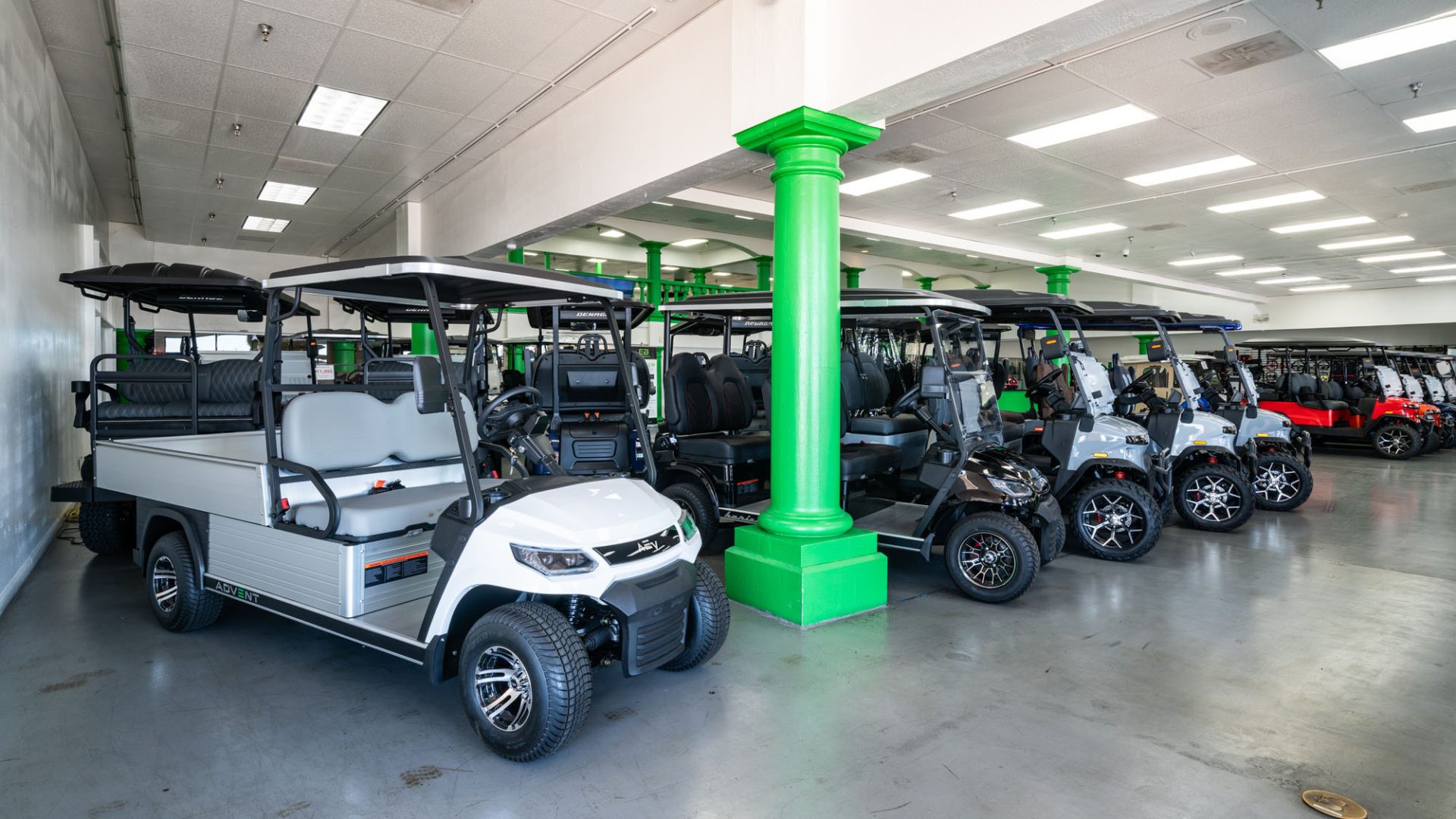
Compare Electric Golf Carts at Golf Car Superstore
Golf Car Superstore in Sun City West carries electric golf carts from manufacturers such as Denago EV, Advanced EV, Atlas Carts, Aries EV, 14 STX, and more.
We serve customers from Sun City West, Sun City, Surprise, Peoria, Glendale, Buckeye, Phoenix, Scottsdale, and surrounding Arizona communities. Our team can help you compare battery types, seating capacities, features, expected range, and maintenance requirements.
Browse our current golf cart inventory or visit Golf Car Superstore to compare available models in person.