
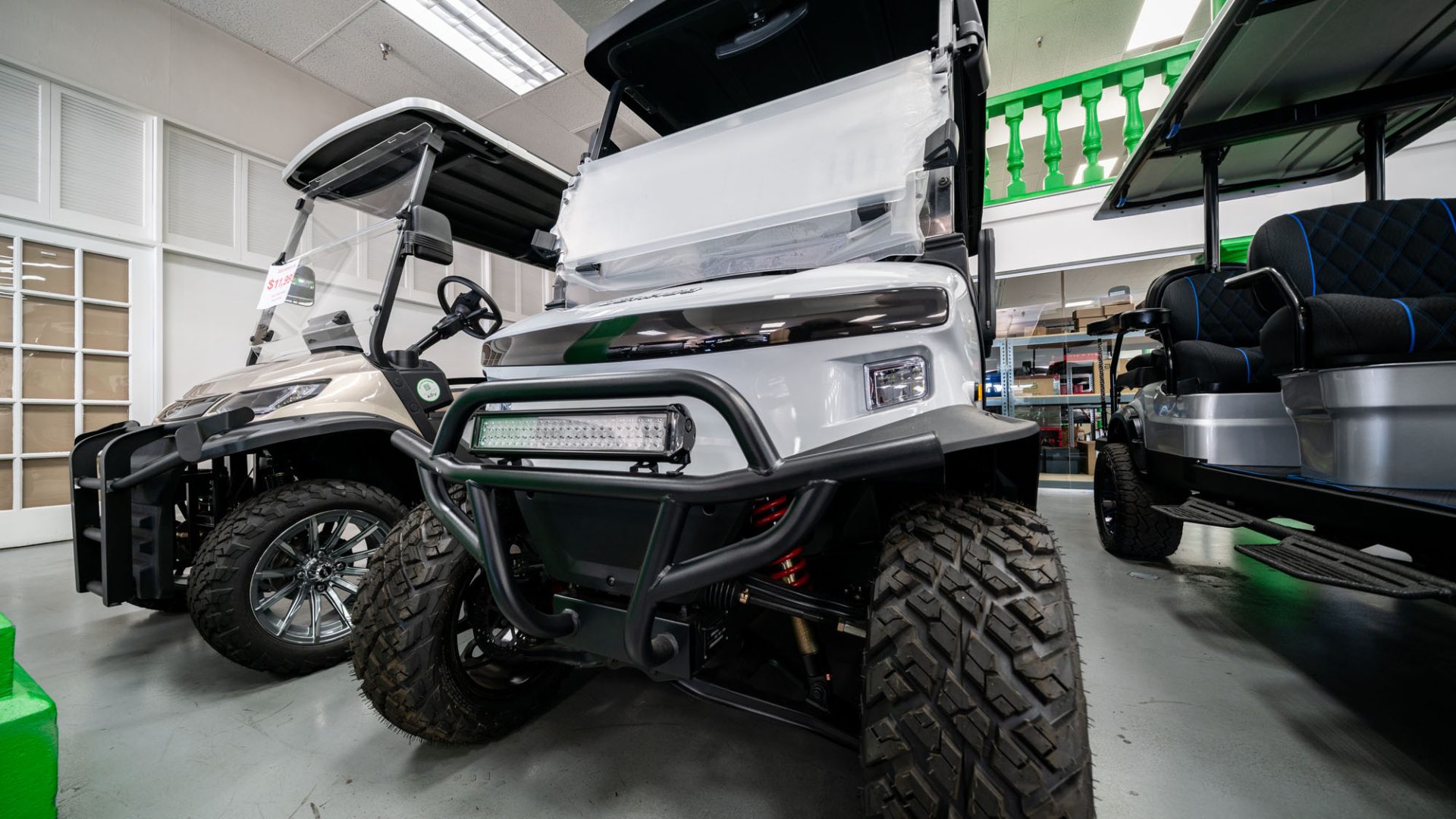
Street-legal golf carts offer a convenient way to travel around Arizona neighborhoods, retirement communities, resorts, and approved local streets. However, not every golf cart is legal for public-road use simply because it has headlights, mirrors, or seat belts.
A vehicle intended for Arizona streets may need to qualify as a federally compliant low-speed vehicle, be titled and registered, carry liability insurance, and follow state and local operating restrictions. Understanding those requirements before buying can help you avoid purchasing a cart that cannot legally be used where you planned to drive it.
Golf Cart, LSV, and NEV: What Is the Difference?
The terms golf cart, low-speed vehicle, and neighborhood electric vehicle are often used interchangeably, but they do not always describe the same type of vehicle.
- Golf cart: A smaller, low-speed vehicle traditionally designed for golf courses, private property, and community transportation. A conventional golf cart may not satisfy federal requirements for public-road use.
- Low-speed vehicle: An LSV is a federally recognized vehicle category. It generally includes four-wheeled motor vehicles designed to travel faster than 20 mph but no faster than 25 mph and certified to meet Federal Motor Vehicle Safety Standard No. 500.
- Neighborhood electric vehicle: An NEV is an electric LSV. Arizona defines an NEV as an emission-free, electrically powered vehicle with at least four wheels that complies with applicable federal low-speed-vehicle standards.
The important distinction is certification. Adding a light kit to a basic course cart does not necessarily transform it into a federally compliant LSV. Before purchasing, ask whether the vehicle was manufactured or properly certified for road use and whether it has the necessary documentation for an Arizona title and registration.
What Equipment Does a Street-Legal Golf Cart Need?
Federal low-speed-vehicle standards require specific safety equipment. A compliant LSV generally needs:
- Headlights
- Front and rear turn signals
- Taillights and brake lights
- Red reflectors
- A parking brake
- A compliant windshield
- Rearview mirrors
- Seat belts at every designated seating position
- A vehicle identification number
- A manufacturer certification label showing compliance with applicable federal safety standards
Additional equipment may be required by Arizona law, the vehicle’s classification, or local rules. Equipment can also vary between model years and configurations, so inspect the exact cart you intend to purchase instead of relying solely on an advertisement or a similar model.
A windshield wiper, horn, speedometer, or other feature may be useful or required in certain circumstances, but the complete compliance determination should come from the vehicle documentation and applicable authorities—not from an accessories checklist alone.
Where Can an NEV Be Driven in Arizona?
Arizona law limits an NEV’s operating speed to no more than 25 mph. An NEV generally cannot be driven on a street or roadway with a posted speed limit above 35 mph. It may cross a road with a higher posted limit at an intersection when the crossing is otherwise permitted.
These restrictions mean that a street-legal cart is best suited for neighborhood travel and short local trips. It is not a replacement for a passenger vehicle on highways, interstates, or faster arterial roads.
Arizona also has special shoulder-use provisions for golf carts and NEVs in certain qualifying age-restricted communities in unincorporated areas. Those provisions do not automatically apply to every community or roadway. Check the exact route, posted signs, community rules, and local ordinances before driving.
Private communities, homeowner associations, resorts, and golf courses may establish rules that are more restrictive than state law. A cart that is legal under Arizona law may still be prohibited on a particular private road or pathway.
Arizona License, Title, Registration, and Insurance Requirements
A driver generally needs a valid driver’s license to operate a motor vehicle on an Arizona public highway unless a specific exemption applies. A golf cart or NEV should not be treated as an unlicensed children’s vehicle merely because it is smaller and slower than a car.
Before operating a qualifying cart on public roads, owners should be prepared to address:
- Proof of ownership: Confirm that the seller can provide a valid title or the documents needed to obtain one.
- Vehicle identification: Verify that the VIN on the vehicle matches the title, sales documents, and certification information.
- Arizona registration: A motor vehicle operated on an Arizona highway generally must have current registration unless an exemption applies.
- License plate: Confirm the applicable plate and display requirements during registration.
- Liability insurance: ADOT states that every vehicle operated on Arizona roads must be covered by Arizona liability insurance, including golf carts.
- Driver restrictions: The operator must follow applicable licensing, permit, and passenger restrictions.
Requirements and fees can depend on the vehicle and its documentation. Contact the Arizona Motor Vehicle Division or an authorized third-party provider before buying if the seller cannot clearly explain how the cart will be titled and registered.
What to Check Before Buying a Street-Legal Golf Cart
Use the following checklist when comparing vehicles:
- Confirm its classification. Ask whether it is a conventional golf cart, federally compliant LSV, or Arizona-recognized NEV.
- Inspect the certification label. Look for manufacturer information showing compliance with applicable federal motor-vehicle safety standards.
- Verify the VIN and title. Make sure every document matches the vehicle.
- Check the maximum speed. An Arizona NEV may not be operated faster than 25 mph.
- Inspect every safety feature. Test the headlights, brake lights, turn signals, parking brake, mirrors, horn, seat belts, and windshield.
- Confirm passenger capacity. Every passenger needs a designated seat and appropriate restraint. Never assume a rear cargo platform is an approved passenger position.
- Evaluate the battery and range. Ask about battery type, capacity, expected real-world range, charging time, charger compatibility, and warranty coverage.
- Get an insurance quote. Confirm that the vehicle can be insured for its intended use before completing the purchase.
- Map your expected routes. Check road speed limits, crossings, community restrictions, parking, and charging access.
- Ask about local service. Make sure parts, battery support, electrical diagnosis, and warranty service are available nearby.
Benefits and Limitations of Street-Legal Golf Carts
For the right owner, an electric LSV can provide quiet, convenient transportation for trips to a community center, golf course, neighbor’s home, local business, or other nearby destination.
Potential advantages include:
- Lower energy and maintenance costs than many full-size vehicles
- Quiet operation
- Zero tailpipe emissions
- Easier parking and maneuverability
- Two-, four-, and larger passenger configurations
- Comfortable transportation for short community trips
Buyers should also consider the limitations. An LSV offers less crash protection than a passenger car, cannot use faster roads, has limited weather protection, and may provide less range and storage. Arizona heat can also affect passengers, tires, batteries, upholstery, and other components.
Maintain the Cart for Safe Road Use
Street use places additional responsibility on the owner. Regularly inspect the tires, brakes, steering, lights, mirrors, seat belts, battery, and charging system. Address pulling, unusual noises, reduced range, dim lights, steering play, or increased stopping distance before returning the cart to public roads.
Performance modifications require particular care. Increasing speed, changing tire size, altering the controller, or modifying the battery system may affect handling, braking, warranty coverage, legal classification, and federal certification. A cart that can travel faster is not automatically safer or more legal.
Shop Street-Legal Golf Carts in Arizona
Golf Car Superstore can help Arizona buyers compare electric golf carts and LSV-style vehicles based on passenger capacity, battery range, features, documentation, and intended use.
We serve customers throughout Sun City West, Surprise, Peoria, Glendale, Goodyear, Phoenix, Buckeye, Scottsdale, Show Low, Pinetop, and surrounding Arizona communities. Our team also provides financing options, trade-in assistance, parts, accessories, battery service, and ongoing maintenance.
Browse our current golf cart inventory or visit Golf Car Superstore to compare available models in person. Before purchasing, our team can help you identify the equipment and documentation associated with the exact vehicle you are considering.
Road-use requirements can change and may vary by jurisdiction. Verify current federal, Arizona, local, and community rules before purchasing or operating any golf cart or low-speed vehicle on public roads.